Sustainability Through Future-Proofing: Infrastructure Decisions as an ESG Imperative
- Datacom Solutions
- Industry News
- 02.03.2026
Environmental, Social, and Governance (ESG) commitments are reshaping how organizations plan, invest, and operate. From energy and facilities to procurement and IT, leaders are asking a simple question with complex implications: How can we make sure we design today’s buildings for tomorrow?
There’s an often-overlooked answer rooted in the fundamentals: low voltage cable infrastructure can be redesigned with environmental benefits in mind. Smart choices can reduce the need for secondary hardware, lower energy consumption, slash potential points of failure, and keep electronics out of landfills. And with modern solutions - like the GameChanger® Cable from Paige® that supports 100W PoE and 2.5 Gb/s Ethernet over 200 meters - you can align network performance with sustainability goals without compromising scale or reliability.
The ESG Lens on Network Infrastructure
Most sustainability initiatives focus on high-visibility efforts - renewable energy procurement, efficient HVAC systems, and data center optimization. But the overlooked connective tissue of the modern enterprise is the physical network layer: cable plants, PoE-powered devices, and the passive and active components between them.
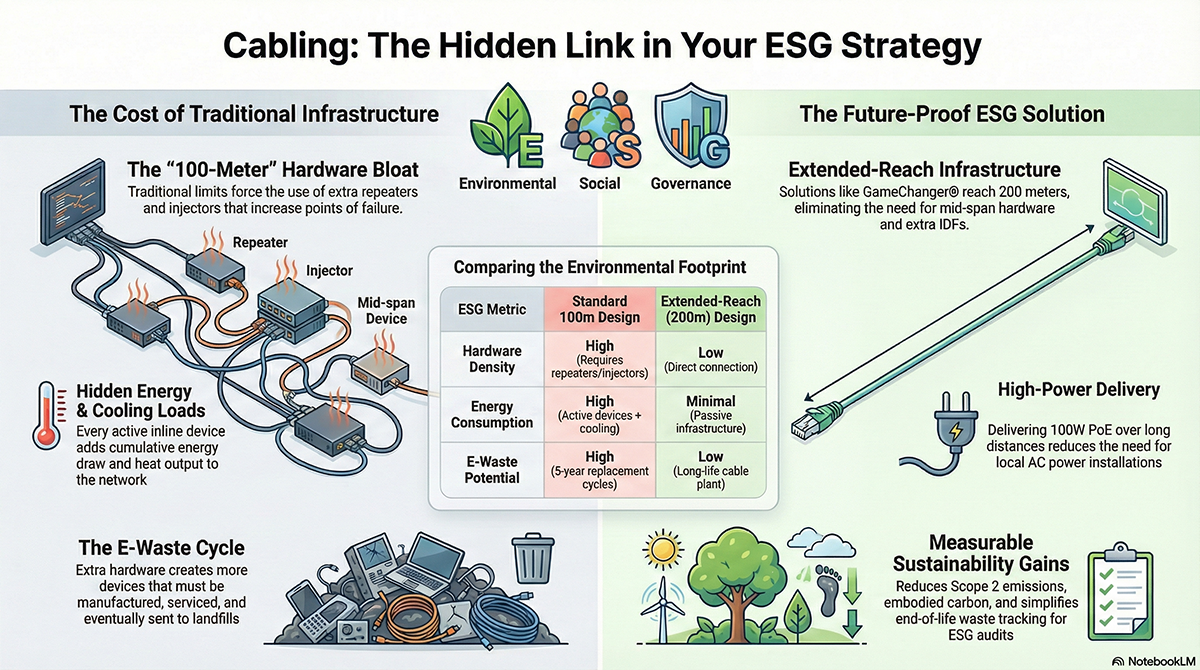
The common ICT infrastructure practices of the last 30 years have required organizations to compensate for their 100 meter limitations with extra hardware: repeaters, mid-span power injectors, media converters, and transceivers. Each added device draws power, generates heat, requires maintenance, and eventually becomes waste. Conversely, when you extend reach and power delivery in the cable plant itself, you shrink the hardware footprint, reduce energy use, and extend life cycles - three concrete wins for ESG.
Why Future-Proofing Cabling is a “Smart Green Decision”
- Lower Energy and Cooling Loads - Every inline device adds a small but cumulative energy draw and heat output. Reducing these devices lowers direct energy consumption and indirectly reduces cooling demands in enclosed spaces like IDFs and remote enclosures. Over thousands of endpoints, this compounds quickly into measurable Scope 2 reductions.
- Lower Incoming Carbon Footprint - The easiest way to reduce the carbon footprint of IT equipment is to prevent it from ever being made. The old design practices based around 100 meter limitations required a variety of additional electronics. Design around those limitations and eliminate the requirement for the products to ever be manufactured and transported to your facility in the first place.
- Less Electronic Waste (e-waste) - Extra hardware means more devices to replace on three- to five-year cycles. When you design for longer cable runs and higher PoE power at the outset, you eliminate entire layers of electronics that would otherwise need to be purchased, deployed, serviced, and disposed of later. That’s fewer SKUs, fewer returns, fewer batteries and power supplies - less waste, period.
The GameChanger® Example: Extending Reach, Reducing Waste
In large campuses, warehouses, or outdoor perimeters, the 100-meter Ethernet limit often forces unnecessary infrastructure—extra IDFs, powered enclosures, repeaters, and added AC circuits. Each introduces materials, energy use, and future e waste.
GameChanger extends reach to 200 meters while delivering 2.5 Gb/s and 100W PoE, allowing teams to:
Eliminate mid span injectors, repeaters, and extra transceivers
Avoid new IDFs—and their construction, electrical work, HVAC load, and long-term maintenance
Power devices directly without installing local AC power
Reduce BOM items, packaging, and installation steps
This directly drives ESG impact.
Every IDF, device, or power circuit you don’t install avoids embodied carbon, ongoing energy consumption, and future e waste. By enabling more coverage with fewer components, GameChanger lowers the environmental footprint of both installation and long-term operations, turning smarter design into measurable sustainability gains.
ESG in Practice: Where the Gains Show Up
Environmental
- Material reduction: Fewer enclosures, power supplies, and electronics lowers embodied carbon and waste.
- Operational emissions: Reduced device count and heat output trim energy use over the life of the network.
Social
- Reliability & safety: Fewer devices and failure points improve campus safety systems (cameras, access controls) and occupant experience (Wi-Fi, lighting).
- Worker efficiency: Streamlined installs mean fewer disruptive build-outs, safer cable routes, and less rework.
- Worker Safety: Fewer service calls at dangerous sites like Class I Division 1 Hazardous Locations.
Governance
- Lifecycle accountability: Designing for greater reach and power means deploying fewer components over time, which simplifies tracking embodied carbon, energy use, and end of life waste—making ESG impacts measurable and auditable.
- Risk management: Simplified infrastructure reduces operational risk and unplanned spend due to outages or midlife retrofits.
Use Cases That Benefit Immediately
- Education & Campus Environments: Long hallways, athletic fields, and parking lots often exceed 100 meters. Future-proof cabling reduces outdoor enclosures and power needs.
- Warehousing & Logistics: High-bay Wi-Fi and camera placements across large footprints benefit from extended PoE distances without extra electronics.
- Retail & Mixed-Use: Digital signage and smart lighting in expansive stores and atriums can be powered directly over long runs.
- Healthcare & Corporate Offices: Mission-critical uptime and quiet operations benefit from fewer active devices and more resilient cabling.
- Smart Cities & Outdoor Venues: Perimeter cameras, access control, and IoT sensors often push past 100 meters - extended PoE eliminates repeaters and power pedestals.
- Arenas & Venues: Gathering places that have challenging IT needs and wide spaces to cover benefit from the reach and flexibility of an extended distance design.
- Transportation: Airports, Train Stations and Parking Facilities all have high requirements for Security, Infotainment, Digital signage, and Emergency Phones.
A Practical Framework: How to Quantify the Impact
- Baseline Your Current Architecture
- Number of endpoints requiring >100m runs
- Inline hardware required (injectors, repeaters, media converters)
- Energy draw per device and thermal profile
- MTBF/maintenance history and truck roll frequency
- Model an Extended-Reach Design
- Replace inline hardware with extended-reach cabling (e.g., GameChanger)
- Calculate device count reduction and energy savings
- Estimate e-waste avoided over a 5–7 year lifecycle
- Tie Results to ESG Reporting
- Map reductions to Scope 2 emissions and waste metrics
- Document lifecycle extension and deferred capital expenditures
- Incorporate into procurement guidelines and design standards
- Pilot & Scale
- Start with a high-impact site (warehouse aisle, parking perimeter, stadium concourse)
- Validate performance and savings, then codify as a standard
Addressing Common Questions
“Will we limit future bandwidth?”
Supporting 2.5 Gb/s provides ample headroom for most edge devices today (Wi-Fi 6/6E APs, cameras, IoT). The extended reach allows you to deploy where needed without redesigning. For fiber uplinks or ultra-high-throughput backbones, cabling plans can blend fiber with extended-reach copper at the edge to optimize cost and sustainability.
“What about power budgets?”
100W PoE (e.g., IEEE 802.3bt Type 4) covers a wide range of high-power devices. Extended-reach cabling designed for efficient power delivery minimizes voltage drop and ensures device stability over longer runs.
“Isn’t this just an IT decision?”
It’s an ESG decision with IT implications. Infrastructure choices shape long-term environmental impact, operational cost, and reliability. Cross-functional collaboration - Facilities, IT, Procurement, and Sustainability - is essential.
The Bottom Line
Future-proofing cable infrastructure delivers measurable sustainability benefits: less waste, lower energy, fewer failures, and longer life cycles. With a solution like the GameChanger® Cable from Paige® that supports 100W PoE and 2.5 Gb/s up to 200 meters, organizations can deploy smarter, cleaner networks that stand up to today’s demands - and tomorrow’s - without layering in unnecessary hardware.
If ESG is about long term decisions, then the cable plant — the permanent network infrastructure that stays in place for decades — is one of the most consequential.
Build once. Build right. And build green.
David Coleman
SVP of Datacom and US Data Centers
Datacom Solutions
Paige Datacom connects your security, fire, access control, audiovisual, signage, high voltage, irrigation, asset protection, and structured cabling systems with the highest-performing solutions in the industry for both enterprise and data center markets.
Learn More